Skin cancer
Know Your Skin: Why Early Detection of Skin Cancer Matters
Learn about common skin cancers, changes to notice and why early assessment matters.
Know Your Skin: Why Early Detection of Skin Cancer Matters
Your skin is your body's largest organ, and paying attention to changes in it could make a life-saving difference.
Skin cancer develops when abnormal cells grow uncontrollably in the skin. Some forms are strongly associated with ultraviolet (UV) exposure, while others may develop through different biological processes.
What are the common types of skin cancer?
There are several types of skin cancer, with the most common including:
- Basal cell carcinoma: Often develops on areas exposed to the sun and may appear as a shiny bump, sore or persistent skin lesion.
- Squamous cell carcinoma: May appear as a scaly patch, firm bump or sore that does not heal.
- Melanoma: A potentially serious form of skin cancer that develops from pigment-producing cells called melanocytes.
What warning signs should you look out for?
One of the most important things you can do is become familiar with your skin.
Watch out for moles that change in size, shape or colour, unusual marks that develop suddenly, sores that don't heal or spots that bleed, itch or crust.
A useful guide when checking moles is the ABCDE rule:
- A – Asymmetry: One half looks different from the other.
- B – Border: Edges appear irregular or uneven.
- C – Colour: Different shades or colours appear within one spot.
- D – Diameter: The spot is often larger than 6mm, although melanomas can be smaller.
- E – Evolving: The mole or spot changes over time.
Not every skin cancer follows these signs, so any suspicious or changing lesion deserves attention.
How is skin cancer diagnosed?
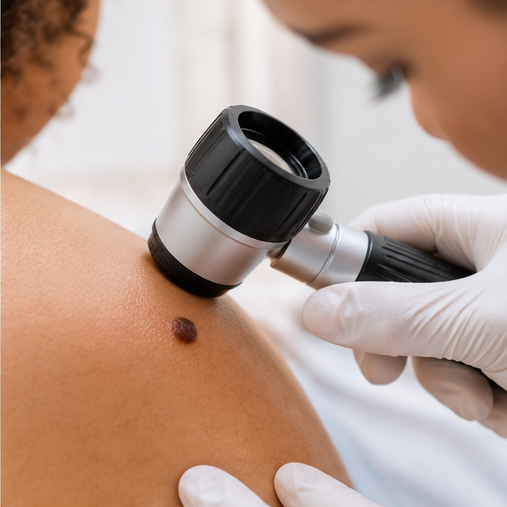
Dermatologists use clinical examinations and specialised tools such as dermoscopy to assess suspicious lesions.
Dermoscopy allows the dermatologist to examine structures within a skin lesion that may not be visible to the naked eye.
Where necessary, a biopsy may be performed to establish a diagnosis.
Can skin cancer be prevented?
While not every skin cancer can be prevented, protecting your skin from excessive UV exposure is an important part of reducing risk.
Protective measures include using broad-spectrum sunscreen, wearing protective clothing, seeking shade and avoiding excessive exposure to direct sunlight.
Why does early detection matter?
Early detection is particularly important because many skin cancers are easier to treat when identified at an early stage.
Don't ignore changes in your skin. If something looks unusual or is changing, have it examined by a qualified dermatologist.